Accessibility Statement

What do I do if I think my child has Special Educational Needs

It may be beneficial for you to start taking notes on your concerns, with examples of how your child presents at home that lead you to be concerned. 

Consider speaking to whoever works at the educational setting that your child attends. This could be nursery staff, a teacher or support staff in school. Take your notes with you, as these will support you in having the conversation. 

It's a good idea to take notes of your conversation, so you can reflect on them later. 

Below is a flowchart you may want to use to help you understand the process. If you click the flowchart, it opens as a webpage with links to click.


First, look at the information about what special needs are on the Local Offer:

What are Special Educational Needs?

And the Information and support for specific conditions section of the Information and Advice page.

It is a good idea to speak with the staff at your child's educational setting (school, college or nursery) or to any professional who knows your child, such as GP, other health professional or social worker.

If you have read the information on the Local Offer and think that your child may have SEND, look at information on how children get support in school:

The support every child should receive 

How children get the help they need to in school

If you have concerns about the support that your child's educational setting (school, college or nursery) are putting in place then it is a good idea to speak with the staff who work with your child or or to any professional who knows your child, such as GP, other health professional or social worker.

If your child is in a school or nursery, they may offer you the opportunity to speak to someone in school who specialises in SEND, called the SENDCO.
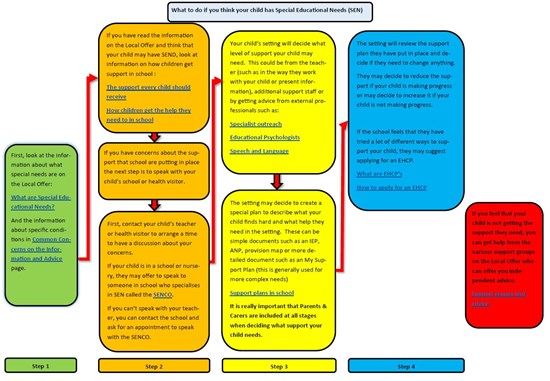
Your child’s setting will decide what level of support your child may need.  This could be from the teacher (such as in the way they work with your child or present information), additional support staff, or by getting advice from external professionals such as:

The setting may decide to create a special plan to describe what your child finds hard and what help they need in the setting.  These can be simple documents such as an Individual Education Plan (IEP), Additional Needs Plan (ANP), provision map, or more detailed document such as an My Support Plan (this is generally used for more complex needs).

Support plans in school

It is really important that parents & carers are included at all stages when deciding what support your child needs.

The setting will review the support plan they have put in place and decide if they need to change anything. 

They may decide to reduce the support if your child is making progress or may decide to increase it if your child is not making progress.

If the school feels that they have tried a lot of different ways to support your child, they may suggest applying for an Education, Health & Support Plan (EHCP).

If you feel that your child is not getting the support they need, you can get help from various support groups who can offer you independent advice.

Inclusion Support Offer (ISO)

The Local Offer has a service called the Inclusion Support Offer (ISO) which provides support for all educational settings (including nurseries) to help to make sure they are doing everything they can to support children with SEND, without necessarily looking at additional funding or making referrals to assessed services. 

You can find more information about this service on our ISO information page.   This service is for schools use only, they do not take calls from parents or carers, but you can mention it to your child's educational setting and ask them to get in touch.

en-GB
Last updated: 04/03/2026