Accessibility Statement

Best Start in Life Plan - April 2026 - March 2029

You can click the image above to open a PDF version of the plan for download. 

Visit the Families Together website for more information on support they can offer. 

Table of contents

1. Executive Summary
2. Introduction
3. Interdependencies and Alignment
4. Vision and Ambition
5. Aims of Kirklees Best Start Plan
6. Kirklees Context
7. Where are we now?
8. What Parents and Carers told us
9. The Key Principles for Delivery
10. Governance and Monitoring
11. Next Steps
12. Appendices

1. Executive Summary

The Kirklees Best Start in Life Plan 2026–2029 sets out a shared, system-wide approach to improving outcomes for children and their families. It is underpinned by a clear ambition to ensure every child in Kirklees has the best possible start in life, regardless of background, need or circumstance, and to increase the proportion of children achieving a Good Level of Development (GLD) at the end of Reception.

Early childhood is a critical period for development, with experiences during pregnancy and the first five years shaping lifelong health, learning and wellbeing. While outcomes in Kirklees have improved, too many children still start school without the communication, language, literacy and mathematical foundations they need. Inequalities remain for disadvantaged children, children with special educational needs and disabilities (SEND), children with English as an Additional Language (EAL), and summer-born boys, particularly in communities facing higher levels of deprivation.

Our Best Start Plan translates national Best Start and Start for Life ambitions into a local, place-based response shaped by Kirklees communities. It aligns with the Government’s ambition for 75% of children nationally to achieve GLD by 2028 and with key local strategies, including Our Kirklees Futures, the Kirklees Council Plan, the Health and Wellbeing Strategy and SEND improvement priorities.

The Plan is structured around the three national pillars of better support for families, more accessible early education and childcare, and improved quality in early years and Reception. Central to the local approach is a strong focus on the first 1001 days, recognising the importance of early attachment, parental wellbeing and infant health. Alongside this, improving school readiness is a core priority, with a focus on strengthening communication, language, early literacy, independence, and physical development.

Delivery will be driven through an integrated Families Together and Best Start Family Hub model, providing accessible, place-based support across Kirklees. Children and families will be supported through joined-up pathways spanning pregnancy, infancy, early years provision, health, SEND, family support and community services.

The Plan places strong emphasis on prevention, early identification and early intervention, improving the use of developmental checks, shared data and evidence-based programmes to identify and respond to emerging needs as early as possible. This includes a clear commitment to improving outcomes for children with SEND and supporting effective transitions into early years settings and school.

A skilled, confident and sustainable workforce across early years, health and family support services is critical to success. The Plan prioritises workforce recruitment, retention, development and leadership capacity.

Strong governance, shared leadership and collective accountability underpin this Plan. Partners across the local authority, NHS, education and voluntary and community sector share responsibility for delivery, embedding co-production so that lived experience informs design, delivery and continuous improvement.

Through this shared commitment, Kirklees will reduce inequalities, improve early development and create the conditions for children to be safe, healthy, achieving, happy and attending – ensuring every child in Kirklees has the very best start in life.

2. Introduction

In Kirklees, we share a clear ambition and a strong collective vision to secure the very best outcomes for children and their families. We believe that the foundations laid in the earliest years shape children’s lifelong health, learning and wellbeing, and that every child, regardless of background, need or circumstance, deserves the opportunity to thrive.

Through strong partnership working across education, health, care, the voluntary and community sector and with families themselves, we are committed to building an inclusive, preventative and high‑quality early support system. Our vision is rooted in reducing inequalities, strengthening family support and resilience, and ensuring that children enter school ready to learn, confident and well supported, giving every child in Kirklees the very best start in life.

Our Kirklees Best Start Plan sets out how we will deliver our ambition, alongside the national ambition, of 75% of five‑year‑olds achieving a Good Level of Development (GLD) by 2028, by strengthening family services, making early education and childcare more accessible and affordable, and improving quality in early years and Reception.

Kirklees Best Start Plan translates national strategy into a local, place‑based programme shaped by Kirklees families, partnerships and communities.

3. Interdependencies and Alignment

The Kirklees Best Start Plan is closely aligned with key local and national strategies to ensure a coordinated, whole‑system approach to improving outcomes and safeguarding children from pre‑birth through early childhood and beyond.

Delivery is intentionally integrated with the Families First Partnership Programme (FFPP), the Integrated Neighbourhood Health agenda, the Healthy Child Programme (HCP), the Kirklees SEND Partnership: SEND – The Big Plan, and national Early Years reforms.

Best Start in Life forms the early‑years foundation of the Families Together model, with a focus on pregnancy to age five. Where wider and whole family needs or safeguarding concerns are identified, families transition seamlessly to other provisions within the Families Together Family Hubs and/or FFPP through shared pathways and multi‑agency Team Around the Family working. This ensures early help, targeted support and statutory responses operate as a single continuum.

Alignment with the Integrated Neighbourhood Health agenda embeds Start for Life priorities into place‑based delivery. Families Together and Best Start Family Hubs act as neighbourhood anchors, improving access to integrated health, early years and community services in areas of greatest need, and contribute to the reduction of health inequalities.

The Healthy Child Programme is a core delivery element within the Best Start system, providing universal reach through health visiting, developmental reviews and early identification of need. Integrated pathways between HCP provision, early years, SEND and family support services strengthen safeguarding, increase uptake of checks such as ASQ at 2–2.5 years, and enable timely intervention when concerns emerge.

The Plan directly supports the Kirklees SEND Partnership: SEND – The Big Plan by prioritising early identification, inclusive practice and smoother transitions into early years and school. Joint workforce development, shared pathways and co‑production with families ensure SEND reforms are implemented consistently across universal and early help services. 

Through alignment with national Early Years reform, the Best Start Plan ensures that increased access to childcare and early education is matched by a strong emphasis on quality, inclusion and safeguarding.

Together, these interdependencies create a coherent system focused on prevention, early identification and protection, ensuring children in Kirklees are safe, supported and able to thrive

4. Vision and Ambition

Kirklees Best Start Plan aligns with the three pillars set out in Giving Every Child the Best Start in Life Strategy. It aims to increase the proportion of children achieving a good level of development by the end of reception nationally to 75% by 2028, as part of the Government's Plan for Change:

  • Better support for families
  • More accessible early education and childcare
  • Improving quality in early years, including reception

Ensuring that every child in Kirklees has the best start in life is a shared priority across our local partnership. Kirklees Best Start Plan sets out how we will deliver that ambition between April 2026 and March 2029.

In Kirklees, this mission aligns closely with our existing strategic commitments, including:

Our approach is rooted in a whole‑system commitment to prevention, early identification, inclusion and partnership working. To deliver measurable improvement in early childhood outcomes, we will work collaboratively across education, health, care, voluntary and community organisations, local integrated partnerships, midwifery and 0-19 services, early years providers, commissioned services, and families themselves. The plan has been co‑produced with these partners, including parents and carers, ensuring that lived experience shapes our priorities.

We will focus on breaking the link between background and outcomes, particularly for children living in the most disadvantaged communities. Our local challenge mirrors the national one: while outcomes are improving, too many children start school without the communication, language, literacy or mathematical foundations they need, and too many families face barriers in accessing support. The national strategy outlines major reforms to address these issues, including expanded Family Hubs, a strengthened Start for Life offer, more accessible childcare from nine months, and programmes to raise workforce quality and early years teaching.

Our Kirklees Best Start Plan describes how we will implement these reforms in a way that reflects the strengths and needs of our area. It sets out the outcomes we aim to achieve, the actions we will take together, and the impact we expect for children and their families. Most importantly, it reflects our shared belief that every child in Kirklees deserves the very best start in life, and that achieving this requires whole‑system commitment, partnership and purposeful action.

This vision reflects our collective ambition to create the conditions in which all children can thrive, regardless of background, need or circumstance, and to build a system that works effectively with families, partners and communities to support the best possible outcomes from the very beginning.

5. Aims of the Kirklees Best Start Plan 

Our Kirklees Best Start Plan aims to:

Reduce inequalities in early childhood outcomes
We will break the link between a child's background and their future success by identifying and
responding to the specific needs of babies, young children and families, particularly those living
in communities facing the highest levels of disadvantage in Dewsbury (North Kirklees) and
Huddersfield (South Kirklees).


Improve levels of child development by the end of Reception
We aim to increase the proportion of children in Kirklees achieving a Good Level of
Development (GLD) from 65.5% to 74.5% by 2028. This includes a strong focus on the current
3- and 4-year-old cohort, particularly:

• literacy
• mathematics
• communication and language
• summer-born boys
• children living in the 30% most deprived areas
• Support for families who have children with SEND
• Support for children with EAL


Strengthen early years systems and support
We will embed a whole-system approach that supports families early, improves access to
high-quality early years provision, and enables professionals and services to work together
effectively across education, health, care, voluntary and community sectors.


Ensure the best possible start for every child
By building a cohesive, inclusive and sustainable early years system, we will create the
conditions in which all children in Kirklees can thrive, reach their potential, and transition
confidently into school.

6. Kirklees Context

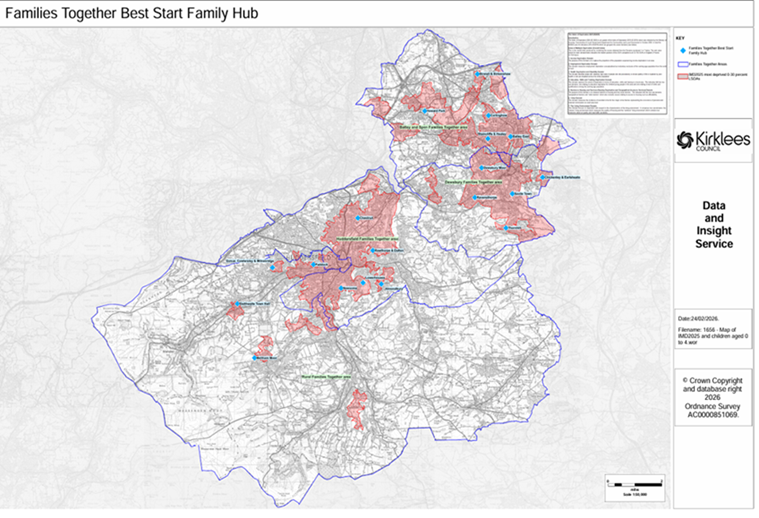
The map below illustrates the four Hub geographies of Kirklees and highlights the areas experiencing the highest levels of deprivation, with the red shading indicating the 30% most deprived neighbourhoods based on the Index of Multiple Deprivation. Levels of vulnerability are most pronounced in the Dewsbury and Mirfield geography, particularly within the Dewsbury locality, with further concentrations in Huddersfield and Batley and Spen, and additional smaller pockets within the Rural geography.

Our Families Together Family Hubs are strategically located across all four geographies, with the greatest concentration in areas of highest need to ensure accessible, place-based support for families.
 Batley and Spen Families Together Geography          
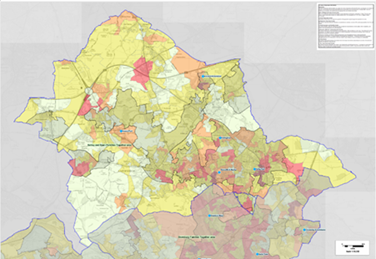
Image of Batley and Spen Families Together Geography

Huddersfield Families Together Geography
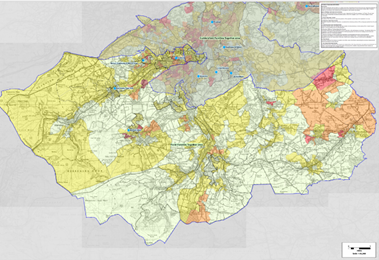
 Huddersfield Families Together Geography

 Dewsbury & Mirfield Families Together Geography   
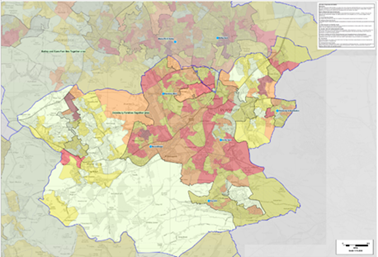
 Dewsbury and Mirfield Families Together Geography  

 Rural Families Together Geography
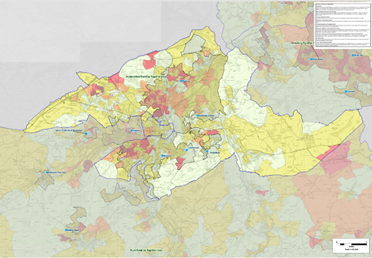
Rural Families Together Geography
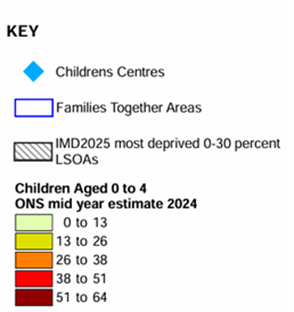
Key of colours of Geography pictures aboveCapita per square KM

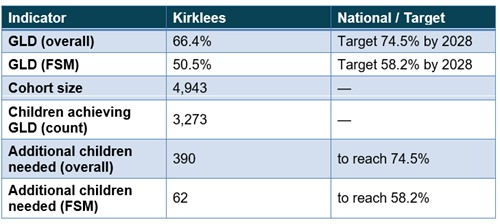
Kirklees has approximately 108,969 children and young people aged 0–19 (including 30,352 aged 0–5). In the 2025 EYFSP cohort (4,943), 66.4% achieved a GLD. To reach the 2028 ambition of 74.5%, an estimated additional 390 children need to achieve GLD overall (including around 62 free school meal (FSM)- eligible children). Gaps are most pronounced in communication, language and literacy, and in mathematics. 

Data Highlights (EYFSP 2024/25)
  Decorative

6.1 Good Level of Development

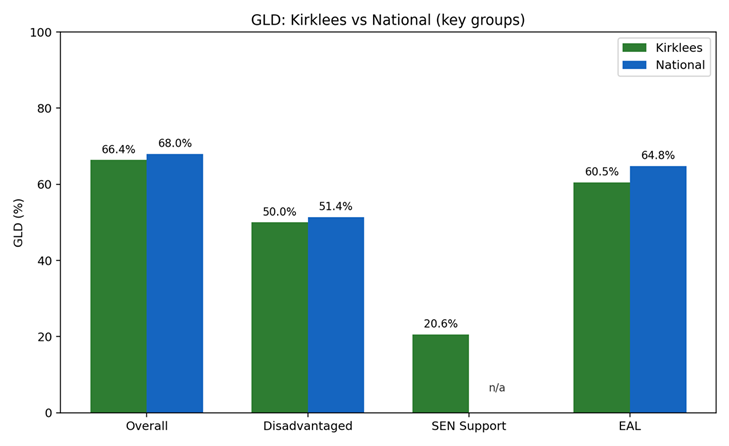
The Early Years Foundation Stage Profile (EYFSP) provides a key measure of children’s readiness for school at the end of Reception. In the 2024/25 cohort, 66.4% of children in Kirklees achieved a Good Level of Development (GLD). While this represents steady improvement over recent years, outcomes remain below the national average, and significant gaps persist for key groups of children.

Performance Overview

  • 66.4% of children achieved GLD (3,273 of 4,943 pupils).
  • 34% (1,670 children) did not achieve GLD, indicating areas for further improvement.
  • GLD outcomes have improved gradually since the pandemic—63% (2022), 65% (2023), 66% (2024 and 2025) but have not closed the gap with national performance.

Disadvantaged Children

Outcomes for disadvantaged children remain an area of concern:

  • 50% of disadvantaged children in Kirklees attained GLD, compared with 51.4% nationally.
  • National and regional outcomes for this group declined by 0.3%, while Kirklees improved by 0.7%, narrowing the gap slightly.
  • The remaining gap between Kirklees and national performance for disadvantaged pupils is 1.9%.


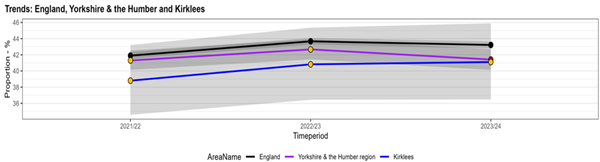
The table below shows the percentage of boys at 5 years with free school meals status achieving a good level of development in Kirklees is lower than the Yorkshire and the Humber region and the England average, with a slight improvement from 2021/22 to 2023/24:
Decorative

Children with Special Educational Needs and Disabilities (SEND)

  • GLD outcomes for children receiving SEN Support are 20.6%, compared with 16% for all children locally; however, this represents a 2.1% decrease since last year
  • Nationally, this group improved by 0.8%, highlighting the need for targeted local action to strengthen early identification and support
  • Outcomes for children with SEND are below national figures in all areas, with the largest gaps in:
    • Communication, Language and Literacy (5.1%)
    • Literacy (4.6%)
    • Mathematics (5.1%)


Children with English as an Additional Language (EAL)

  • Nationally, 64.8% of EAL children achieved GLD, compared with 60.5% in Kirklees
  • Both national and local outcomes improved, with Kirklees showing a slightly stronger improvement (+1.3%, compared to +1.1% nationally)
  • The gap between English-speaking and EAL children in Kirklees is 12.2%, compared with 9% nationally, indicating a need for enhanced support for language development
  • National data shows EAL learners outperforming Kirklees pupils in key learning areas, particularly:
    • Communication, Language and Literacy
    • Physical Development
    • Mathematics

Summary of Need

The data highlights persistent inequalities across the early years, particularly for disadvantaged children, boys with free school meals status, those with SEND, and children with English as an Additional Language. The most significant gaps continue to be in communication, language and literacy, and mathematics - areas that are fundamental to future learning.

Improving GLD outcomes across all groups and closing gaps with national performance will require a whole-system response focused on early identification, high-quality early years provision, strong family support, and targeted interventions where children need them most.

6.2 ASQ Child Development Check at 2 to 2.5 years

The Ages and Stages Questionnaire (ASQ-3) at the 2-to-2.5-year review provides an important early indication of children’s developmental progress across key areas: communication, gross motor skills, fine motor skills, problem-solving and personal-social development.

In Kirklees, 82.1% of children were at or above expected levels across all areas, above the national average of 81.4%. However, only 69.4% of children received the ASQ-3 review, highlighting a local challenge around low coverage.

Performance across 2024/25 ASQ-3 domains:
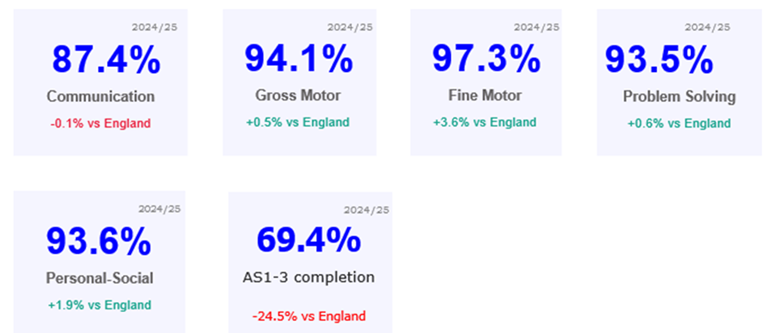
Improving ASQ-3 coverage is crucial for early identification of developmental needs and supports the wider Best Start in Life ambition to improve school readiness and child development outcomes.

6.3 Health Data of our Youngest Children

Children’s early health and wellbeing are strong predictors of their future outcomes, influencing not only physical development but also learning, school readiness and long‑term life chances. Patterns of health service use in the early years also act as an important indicator of how well families can access the support they need.

In England, we know that children from more disadvantaged backgrounds experience poorer health outcomes from their earliest years, and local data reflect similar inequalities across Kirklees.
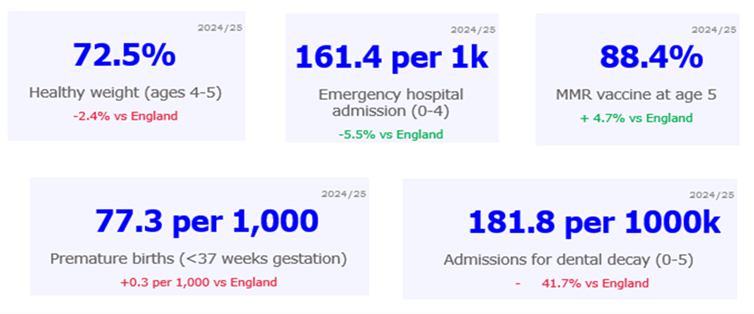
The proportion of children aged 4–5 in Kirklees achieving a healthy weight stood at 72.5% in 2024/25, which is 2.4 percentage points below the England average. This highlights an ongoing challenge around children’s physical health, nutrition, and access to healthy environments. With obesity risk disproportionately higher in communities experiencing deprivation, a targeted, locality‑based approach is essential to address the drivers of unhealthy weight in early childhood.

Emergency hospital admissions for children aged 0–4 years were 161.4 per 1,000 in 2024/25, 5.5% below the England average. While this is positive overall, the rate remains high and reflects pressures related to respiratory infections, accidents, and other preventable conditions. Reducing hospital admissions requires strengthened prevention, improved family support, and consistent pathways across health, early years and community services.

A quarter of five-year-old children in England have tooth decay. This figure can rise to 50% in deprived areas of the country. The most recent local data (2019) showed that 31.2% of 5-year-old children in Kirklees had decayed, missing, or filled teeth, compared with 23.4% in England overall.

6.4 Kirklees Safeguarding Data: Children Aged 0-5

The chart below shows the number of open Child in Need and Child Protection cases in Kirklees, highlighting how many involve children aged 0–5 years.
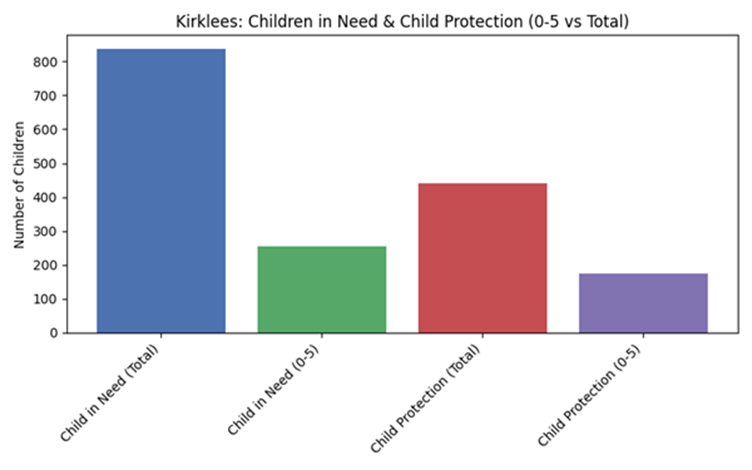
As of February 2026, safeguarding data shows that a significant proportion of the children requiring statutory social care involvement in Kirklees are in their earliest years. Of the 836 open Child in Need (CiN) cases, 254 (30%) relate to children aged 0–5 years.

Similarly, within the 440 open Child Protection (CP) cases, 175 (40%) involve children aged 0–5 years.

This pattern illustrates two key issues. First, infants and young children are naturally more vulnerable and therefore more likely to be identified as needing support when concerns arise. Second, the high proportion of 0-5‑year‑olds within statutory social care reflects the wider pressures faced by families during the early years, such as parental mental health concerns, domestic abuse, poverty, housing instability and challenges with early child development.

These patterns reinforce the importance of a strong, well‑connected early years and Start for Life system. Strengthening prevention, early help, integrated family support, and effective multi‑agency working is essential to reducing the number of young children requiring statutory intervention.

The chart reinforces the importance of strong early intervention, integrated support pathways and accessible family services across Kirklees. By strengthening preventative approaches and ensuring families receive the right help at the earliest stage, we can reduce the need for statutory intervention and improve outcomes for our youngest children.


7. Where are we now?

7.1 Better Support for Families

Here in Kirklees, we are committed to ensuring that families can access the right support at the right time and have developed our Families Together Family Hub model, a place-based universal, integrated early support offer for children, young people and families aged 0- 19 years (up to 25 with SEND) whole family working.

Our Hubs benefit from strong, collaborative partnership working. Partners are highly engaged, communicate effectively and work collectively to ensure a coordinated approach to improving outcomes for children, young people and families.

The Families Together Family Hubs model:

  • Four geographies: Batley and Spen, Huddersfield, Rural, Dewsbury and Mirfield
  • Four main Hubs: Dewsbury Moor, Slaithwaite Town Hall, Birstall and Birkenshaw, and Chestnut Centre, with additional ‘spoke’ Hub sites in each locality for local community delivery and accessibility. We also offer outreach support services via early years, schools and community settings.
  • Key partners work together to plan, coordinate and deliver the Families Together Family Hubs offer that meets local need and population, to include midwifery clinics, health visiting and infant feeding support, delivery of parenting programmes, play and stay sessions, youth services, support for training and employment, reading friends, family play sessions, smoking cessation, sexual health support, SEND cuppa and chat sessions, perinatal mental health support groups and skills bootcamps.
  • Families Together area partnerships commissioned 4 VCSE sector providers who facilitate local networks, including professionals, parents, recruit parent champions, family events, advice fairs and SEND events.
  • Our Kirklees Parenting Together offers a range of evidence-based parenting interventions that strengthen relationships and attachment, improve children’s behaviour, emotions, and learning, boost parental confidence, and support school readiness.
  • The Best Start in Life programme interfaces closely with the Families First Partnership Programme (FFPP) through the Families Together Family Hubs model, providing a seamless, place‑based system of early help and whole‑family support. Best Start in Life focuses on pregnancy to age five, strengthening early childhood development, parenting, health and the home learning environment. When wider family needs are identified, families can be supported to access wider family help through the Families Together Family Hubs, enabling coordinated multi‑agency assessments, Team Around the Family planning and targeted whole‑family interventions.
  • Kirklees Families Together interfaces with Community Plus and Libraries in Kirklees through an integrated, place‑based early support system. Community Plus provides relational early help, working within the same local geographies as the Families Together model to support families before issues escalate. Libraries, some co-located in Families Together Family Hubs, contribute by supporting early literacy, offering universal early‑years sessions, and acting as accessible community spaces that extend the Best Start home‑learning and early‑language priorities. Together, these services strengthen prevention, widen access, and help reduce inequalities, forming a core part of the Best Start system.
  • The Healthy Child Programme (HCP) in Kirklees is delivered through the 0–19 health services, including health visiting, infant feeding support, child development checks and targeted help for vulnerable families. These services continue to be delivered by Locala as part of the universal and targeted 0–5 health offer. HCP forms a core part of the Families Together model by delivering universal health visiting and early health support services through the Families Together model, enabling families to access health, wellbeing, parenting and early support through the same pathways across the four Family Hub geographies. Together, the Healthy Child Programme, Best Start in Life and Families Together create a whole-system prevention and early-intervention approach, ensuring families receive timely support that strengthens health, development and early childhood outcomes.
  • Home-Start Kirklees is commissioned to provide three strands of intervention: direct support to families with young children, volunteering development and support, and partnership working. This aligns with the Families Together Family Hubs model, which brings services together from conception through to 19/25 years, offering help with parenting, emotional wellbeing and mental health, and early years support. Home-Start delivers relational, home-based support that complements Families Together’s place-based early help system. The contract also aligns with the Best Start in Life strategy by strengthening the home learning environment, supporting parental confidence, identifying early developmental needs, and reducing inequalities. Home-Start’s targeted family support, work with vulnerable groups, and volunteer-led capacity building directly contribute to Best Start priorities. Together, these frameworks reinforce a unified early support system that connects health, early years, community and voluntary services to improve outcomes for young children and their families in Kirklees.
7.2 More Accessible Early Education and Childcare

In Kirklees, we had 90% take-up of Early Learning for 2-year-olds in Autumn 2025, which compares favourably to other LAs. This is underpinned by dedicated support which targets potentially eligible parents, helping them with applications and securing suitable childcare places, with 95-98% take-up of the universal 3-4-year-old entitlement.

The December 2025 Childcare Sufficiency Assessment concluded that:

  • There are sufficient childcare places overall in Kirklees.
  • The average cost of childcare continues to increase.
  • The number of providers rated Good or Outstanding by Ofsted remains high.
  • The number of childminders continues to decline.
  • The population of children under 5 continues to decline.
  • The population of primary-age children continues to decline.
  • Take-up of universal early learning and childcare remains high.


Regarding the national expansion of the free early years entitlement for working parents, most areas have sufficient provision to meet demand. Some localised pressures were identified, but surrounding areas had surplus places. The situation remains under constant monitoring.

As of Summer 2025, 97% of 3-4-year-olds at SEN Support were accessing their full universal entitlement (15 hours), with 94% of children with an EHCP aged 3-4 accessing their full 15-hour entitlement.

A childcare brokerage service is available for families and professionals where placement issues arise. Current data indicates no significant issues in securing places.

7.3 Improving Quality in Early Years, including Reception

Our Challenge and Support Strategy focuses our quality improvement work on those settings that need targeted support to meet the ‘expected’ grade (at a minimum) in Ofsted inspections.

Our Quality Improvement Activity to support our PVI providers includes:

  • Comprehensive training programme informed by inspection findings and GLD data, with universal and bespoke in‑house support.
  • Workforce recruitment and retention plan, including partnerships with colleges, universities and Jobcentre Plus, and leadership development pathways.
  • Termly networks for owners and managers to share best practice and hear updates.
  • Delivery of the 'Think Equal' project across 94 settings (83 PVIs and 11 schools).
  • Early Years Development Board (EYDB) collaboration focused on improving outcomes, with a current emphasis on speech and language pathways
  • Two‑year‑old Quality Offer available to schools and settings, including audits, external reviews and training.
  • Signposting to national offers such as SPH, National Literacy Trust and NDNA.

To complement the national RISE programme, the local authority offers targeted, bespoke support to schools with a 'less than good' judgment or those at risk of not meeting the expected EYFS grade. As of March 2026:

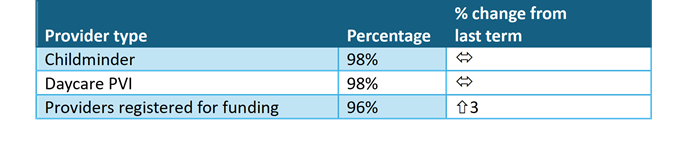
Table shows that out of 78 Maintained Schools and Academies, 59 were rated as Good, 10 as Outstanding and 9 as Requires Improvement.

Further Support for Schools includes:

  • Termly EYFS leadership networks to strengthen leadership practice.
  • Targeted training including use of the DfE 'Analysing Your FSP Data' tool and handwriting in EYFS.
  • Termly EYFSP support sessions focusing on accurate assessment and professional dialogue.
  • Access to the 2‑year‑old QI package (audits, reviews, training).
  • Signposting to RISE, Stronger Practice Hubs, literacy and numeracy hubs, and research schools.


7.4 Improving Health Outcomes

Preconception, maternal health, and oral health among under-5s are key priorities within the Starting Well agenda. In relation to preconception, we are working with West Yorkshire Healthier Together to finalise the preconception content for the website. Community engagement through the women’s health hub has generated positive feedback on the importance of preconception support.

To support maternal health, the PRAMS project, delivered with Auntie Pam’s, is providing online group support to help reduce smoking in pregnancy. Work on maternal obesity is being refreshed, expanding the multi‑agency group across Calderdale, Kirklees and Wakefield, with a potential shift toward a wider preconception focus. A co‑produced leaflet on gestational diabetes has been developed and is available in multiple languages.

To improve oral health in under-5s, a total of 1,400 toothbrushing packs have been allocated to the 0–19 HCP team for distribution at the two‑year developmental review, helping to encourage attendance and support oral‑health discussions. Three oral‑health training sessions have been delivered to health visitors, child‑development practitioners and family‑support workers.

We are delivering supervised daily toothbrushing schemes for young children, focused on the areas of greatest need, targeting 2-5-year-olds in early years settings (school nurseries, private nurseries, childminders and some schools) with a focus on the 10–30% most deprived wards in Kirklees.

Alongside supervised brushing, we have a community‑based oral health element, delivered through commissioned VCS partners including Fresh Futures and Home‑Start Kirklees, which deliver community conversations and sessions with families, embed oral health messages into Stay and Play groups, provide family support in the home and through Community champions’ work, and distribute toothbrush and toothpaste packs to vulnerable families.

We deliver a suite of HENRY parenting programmes that, right from the start, include healthy drinks for young children, let’s get active, healthy teeth, starting solids, and preparation for parenthood, targeted at families with children aged 0-5 years. For families with children aged 0-12 years, we deliver: understanding children’s behaviour; eating well for less; fussy eating growing up; and, for parents, looking after ourselves.


7.5 SEND and Inclusion

Kirklees is committed to ensuring that children with special educational needs and disabilities (SEND) receive timely, inclusive and effective support from the earliest years, enabling every child to thrive and achieve their potential. SEND and inclusion are central to the Best Start in Life approach and are embedded across family support, health, early years education and community services.

A strong and well-established Early Years SEND workforce development offer supports private, voluntary and independent (PVI) providers and schools to meet children’s needs confidently within mainstream settings. This combines nationally recognised accredited training, including Elklan, the Level 3 SENCO Award, Portage Workshops and Autism Education Trust training, alongside bespoke local programmes aligned to Kirklees priorities such as speech, language and communication needs (SLCN), supporting play for children with SEND, social, emotional and mental health (SEMH), and parent workshops.

Professional practice is strengthened through termly SENCO networks for both early years settings and schools, locality-based collaboration and access to specialist outreach services.  Increased confidence in the graduated approach has improved early identification and resulted in more robust referrals and stronger evidence of early intervention

High-quality information, advice and guidance for families is a core element of the SEND system in Kirklees. The Kirklees SEND [i] Local Offer provides clear, accessible and up-to-date information about the support services, educational settings and activities available to children and young people with SEND across the borough. It supports families at every stage, from early concerns through to confirmed diagnosis, helping them to understand what support is available and how to access it.

Parents and carers are central to shaping inclusive practice. The Parents of Children with Additional Needs Carer (PCAN) provides trusted information, advice and support for parents and carers, whether they are becoming aware that their child may have additional needs or are supporting a child with a confirmed diagnosis. PCAN plays a vital role in building parental confidence, strengthening co-production, and ensuring that lived experience informs service design, improvement, and evaluation.

Targeted early intervention is further supported through a five-star Portage service, Portage Small Step Stay and Play sessions that reduce isolation and support engagement with early education, an established Reception Transition Fund to strengthen transitions into Reception, and the robust use of SEND Inclusion Fund (SENDIF) to enable inclusive places and timely provision.

Together, this integrated SEND and inclusion approach strengthens early identification, inclusive practice and outcomes for children with SEND and their families across Kirklees.


8. What Parents and Carers told us

8.1 Better Support for Families
  • Parents want accessible, welcoming and relationship-based support delivered in trusted community settings.
  • Families often rely on family, friends, informal networks and trusted professionals before accessing formal services.
  • Trust, familiarity and ease of access are the strongest drivers of engagement.
  • Parents want greater support for their own wellbeing and mental health, alongside practical advice on housing, finances and healthy living.
  • Peer-to-peer support is highly valued for building confidence and reducing isolation, particularly in the early stages of parenting.
  • Parents want joined-up support in one place rather than navigating multiple services.


8.2 More Accessible Early Education and Childcare
  • Stay and Play sessions are highly valued as accessible, informal entry points into early support.
  • Stay and Play helps reduce isolation and build confidence to engage with early education and childcare.
  • Parents value low-pressure, inclusive and community-based activities that encourage early engagement.


8.3 SEND and Inclusion
  • Parents want clearer SEND information, guidance and early advice, particularly when concerns are emerging.
  • Families value support that helps them understand how and when to access SEND support.
  • Parent-led and peer-supported SEND approaches are strongly preferred.


8.4 Access, Engagement and Digital Support
  • Some parents value digital support, but face-to-face support through trusted relationships remains essential.
  • Online information should complement, not replace, in-person services.
  • Parents want clearer, simpler and more visible early help pathways.

Parent feedback strongly reinforces the Best Start approach. Services are most effective when they are relationship-based, place-based, inclusive and focused on early help. The Families Together and Best Start Family Hub model provides a strong foundation for responding to these priorities and improving outcomes for children and families across Kirklees.

9. The Key Principles for Delivery

The key priorities for delivery set out the focused actions our partnership must take to improve early childhood outcomes, particularly raising Good Level of Development (GLD), reducing inequalities, and strengthening early support through Families Together and Best Start Family Hubs in the areas and groups with the greatest need.

What Outcomes Do We Need to Improve?
  • Kirklees aims to increase the Good Level of Development from 66.4% to 74.5% by 2028, requiring an additional 390 children to achieve this.
  • The largest development gaps are in communication, language, literacy, and mathematics, critical for future educational success.
  • A priority for Kirklees is to focus in the first 1001 days to strengthen early attachment, parental wellbeing and infant health, laying the foundations for improved early development and increased achievement of a Good Level of Development at Reception.
  • ASQ coverage at 2-2.5 years is 69.4%, below the needed levels to identify developmental needs.
  • Below-average healthy weight, high tooth decay rates, and preventable hospital admissions affect young children in Kirklees.
  • There is a workforce challenge in the early years sector around recruitment and retention of early years practitioners.


9.1 WHERE do we need to focus our service delivery?

Considering our priority neighbourhoods and communities experiencing the highest level of deprivation while maintaining a strong offer across Kirklees:

  • Our priority geography is the Dewsbury locality with further concentrations of vulnerability in Huddersfield and Batley and Spen, as well as smaller pockets within the Rural geography.
  • In the 2025 EYFSP cohort of 4953 children, 2546 live in the bottom 30% of deprivation postcodes.
9.2 WHO do we need to prioritise?

The priority groups for improvement are:

  • Disadvantaged children, summer-born boys, children with SEND, and EAL learners.
  • Of 836 open Child in Need (CIN) cases, 254 are aged 0-5; of 440 Child Protection (CP) cases, 175 are aged 0-5.


9.3 HOW our shared local approach

This section sets out how partners across Kirklees will work together to deliver the Best Start in Life ambition. It describes the ways of working, structures and approaches that will enable effective implementation, sustained system changes and improved Good Level of Development outcomes.

Integrated Strategic Leadership

Improving outcomes for children requires shared ownership and accountability across the whole partnership. Delivery will be supported by:

  • Strong, integrated leadership through shared governance arrangements, with clear accountability and agreed delivery workstreams aligned to Best Start priorities.
  • Working as a whole system, bringing together early years, health, family support, SEND, safeguarding, mental health, and community services around shared outcomes.
  • Developing and sustaining multidisciplinary Best Start teams, including maternity, health visiting, early years, family help, SEND, mental health and library services, delivering a full early years pathway from preconception and pregnancy through infancy and early childhood to transition into reception.
  • Focusing on long-term, sustainable system change by embedding prevention, early help and partnership working as core ways of working across Kirklees (THRIVE model).


 Early Identification, Prevention, and Early Intervention
  • Embed whole-family working, recognising the importance of parental wellbeing, relationships, and wider circumstances in supporting early child development.
  • Strengthening early identification and early intervention within universal services, using evidence-based screening tools and clear referral pathways.
  • Provide timely, evidence-based interventions including home learning environment programmes, parenting support and speech and language pathways.
  • Strengthen the use of ASQ to identify children at risk of not reaching developmental outcomes.
  • Improve outcomes for children with emerging or identified SEND, supporting effective transitions into early years and school settings.
  • Support approaches to developing speech, language, and communication skills.


Strengthening Workforce Capacity, Skills and Sustainability

Investing in the workforce by:

  • Strengthening workforce recruitment, retention, and development across the Early Years workforce.
  • Investing in workforce development through multi-agency training, peer networks, trauma-informed practice, and shared learning focused on child development and attachment.


Improve accessibility, parent and community engagement

We want to improve access to services and ensure that experience informs delivery as well as design by:

  • Delivering place-based accessible services targeted to where need is greatest from a network of Families Together buildings, Best Start Family Hubs, with outreach to community venues, including early years providers, schools, libraries, faith settings, community pharmacies, and GP practices.
  • Parents and carers will be actively involved in shaping services, testing approaches, and driving continuous improvement.
  • Strengthening the digital offer to improve access to information, advice, and support for families, ensuring clear and consistent pathways across early help, SEND and Best Start services. Digital tools will complement face-to-face provision to widen engagement, support early identification, and reduce barriers, while addressing digital exclusion.
  • We will consider EAL language and support strategies, using home language to support learning.
  • Deliver outreach and work in the home services.
  • Recruiting SEND-trained professionals.


Improve data sharing and the better use of data
  • Improve data sharing and intelligence through agreed information-sharing arrangements, shared outcomes frameworks and consistent monitoring and reporting.
  • Use data to identify children and families at risk of falling behind, target support earlier and inform place-based decision-making.
  • Explore the possibility of implementing a single-view data system.

10. Governance and Monitoring

We are committed to delivering a collaborative and connected system of support, built on strong principles of shared governance and collective accountability. This approach brings together partnership, operational, council, strategic, and political oversight to ensure alignment at every level.

While these elements are already in place, the detailed governance arrangements will be further developed and agreed over the coming weeks, reflecting our ongoing commitment to co-design and continuous improvement. 

11. Next Steps

Over the coming months, we will develop our Best Start Family Hub and Delivery Plan, an operational plan for 2026 to 2029 that describes how we will deliver the Best Start Family Hub and Healthy Babies expectations set out in Part B of the Local Authority guidance.

We will align the Best Start Family Hub with our Families Together Hubs and services for 0-19/25-year-olds, and we will further align it with wider national reforms and policy improvements across children and family services.

12. Appendices

en-GB
Last updated: 05/05/2026

Useful links

i. Giving every child the best start in life - GOV.UK

Giving Every Child the Best Start in Life

ii. Plan for Change

https://www.gov.uk/missions

iii. Kirklees Council Plan, 1st April 2026-31st March 2029

Kirklees Council Plan

iv. Our Kirklees Futures

Our Kirklees Futures

v. Our Kirklees Futures Executive Action Plan

Our Kirklees Futures - Executive Action Plan

vi. Kirklees Council: SEND - The Big Plan 3

Kirklees Council: SEND - The Big Plan

vii. Kirklees Health and Wellbeing Strategy 2022-2027

Kirklees Health and Wellbeing Strategy

viii. Inclusive Communities Framework - Kirklees Council

Inclusive Communities Framework

ix. West Yorkshire ICB Strategic Commissioning Plan

ix. Local Offer Home

Local Offer Home