Accessibility Statement

What are Special Educational Needs and Disabilities (SEND)?

We understand that navigating the world of Special Educational Needs and Disabilities (SEND) may seem overwhelming at first. We're here to help you understand what it means when a child or young person is identified as having special educational needs and/or disabilities.

A child or young person (0-25 whilst in Education) is considered to have special educational needs and disabilities (SEND) if they face challenges with their learning and/or have a disability that may require extra educational support. This additional support is often referred to as "special educational provision."

  • If a child or young person has a significantly greater difficulty in learning than the majority of others of the same age.
  • If a child or young person has a disability that hampers their ability to benefit from the educational resources typically offered to others of the same age in regular school environments, they may also fall into the category of having special educational needs. This could include physical, sensory, cognitive, or developmental challenges.

In both cases, the goal is to ensure that children and young people receive the appropriate support they need to thrive in their educational journey. This support could include tailored teaching methods, additional resources, specialised equipment, or other measures that enable them to access education effectively. It is important to recognise that every child is different and therefore, each child will need a personalised approach to their learning environment. 

Remember, this process is designed to provide the best possible learning experience for your child. If you have any questions or concerns, don't hesitate to reach out to your child's school or educational institution - or you can contact the Local Offer contact us at LocalOffer@kirklees.gov.uk or call us on 01484 416919 . They will guide you through the necessary steps to ensure your child's needs are met and that they can reach their full potential.

Many children and young people will have SEND of some kind at some time during their education.  Early years providers (for example, nurseries or childminders), mainstream schools, colleges and other organisations can help most children and young people succeed with some changes to their practice or additional support. But some children and young people may need extra help for some or all of their time in education and training.
For children aged two or more, special educational provision is educational or training provision that is additional to or different from the normal education providing for children or young people of the same age by mainstream schools, maintained nursery schools, mainstream post-16 institutions or by relevant early years providers.  For a child under two years of age, special educational provision means educational provision of any kind.

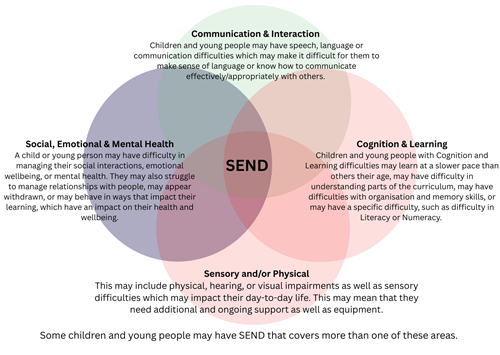
SEND is broken down into four areas:

Image showing overlap of 4 areas of SEND

You can click the name of each area below to find out more.

  • Cognition and learning (opens link in same window) – for example, where children and young people learn at a slower pace than others their age, have difficulty in understanding parts of the curriculum, have difficulties with organisation and memory skills, or have a specific difficulty affecting one particular part of their learning performance such as in literacy or numeracy.
  • Communication and interaction (opens link in same window) – for example, where children and young people have speech, language and communication difficulties which make it difficult for them to make sense of language or to understand how to communicate effectively and appropriately with others.

Some children and young people may have SEND that covers more than one of these areas. 

Many children and young people who have SEN may also have a disability. A disability is described in law by the Equality Act 2010 (opens link in new window) as ‘a physical or mental impairment which has a long-term (a year or more) and substantial adverse effect on their ability to carry out normal day-to-day activities.’ This includes, for example, sensory impairments such as those that affect sight and hearing, and long-term health conditions such as asthma, diabetes or epilepsy. 

The Equality Act requires that early years providers, schools, colleges, other educational settings and local authorities: 

  • must not directly or indirectly discriminate against, harass or victimise disabled children and young people.
  • must make reasonable adjustments ,including the provision of auxiliary aid services (for example, tactile signage or induction loops), so that disabled children and young people are not disadvantaged compared with other children and young people. This duty is what is known as ‘anticipatory’ – people also need to think in advance about what disabled children and young people might need. 

Children with SEND related to cognition and learning often have a learning difficulty. Learning difficulties are classified in the following ways:   

Specific Learning Difficulty (SpLD) - Specific learning difficulties include Dyslexia, Dyspraxia and Dyscalculia. A child with SpLD may require some support in school targeted to their specific area of difficulty such as spelling or numeracy (see information below).

Moderate Learning Difficulty (MLD) - A child with MLD may take longer to learn skills than the majority of their peers and are likely to require extra support in school.   

Severe Learning Difficulty (SLD) - A child with SLD will have significant learning impairments which will impact their ability to learn without high levels of specialist support.   

Profound and Multiple Learning Difficulty (PMLD) -  A child with PMLD will have complex learning needs. In addition to severe learning difficulties they may have physical difficulties, sensory impairment or a severe medical condition. A high level of specialist support will be needed at all times.   

If your child’s first language is not English, does that mean they have a learning difficulty?

The law says that children and young people do not have learning difficulties just because their first language is not English, although, of course, some of these children and young people may have learning difficulties.

For specific information about individual conditions, please see the Specific Conditions page.


There are lots of abbreviations used when talking about SEND, you can find an explanation of the most common ones in the Local Offer Jargon Buster 

en-GB
Last updated: 18/12/2023

Useful links

SEND Guide for Parents

SEND Guide for Parents